Seychelles Company Formation vs Estonia OÜ: Choosing the Right Company Structure

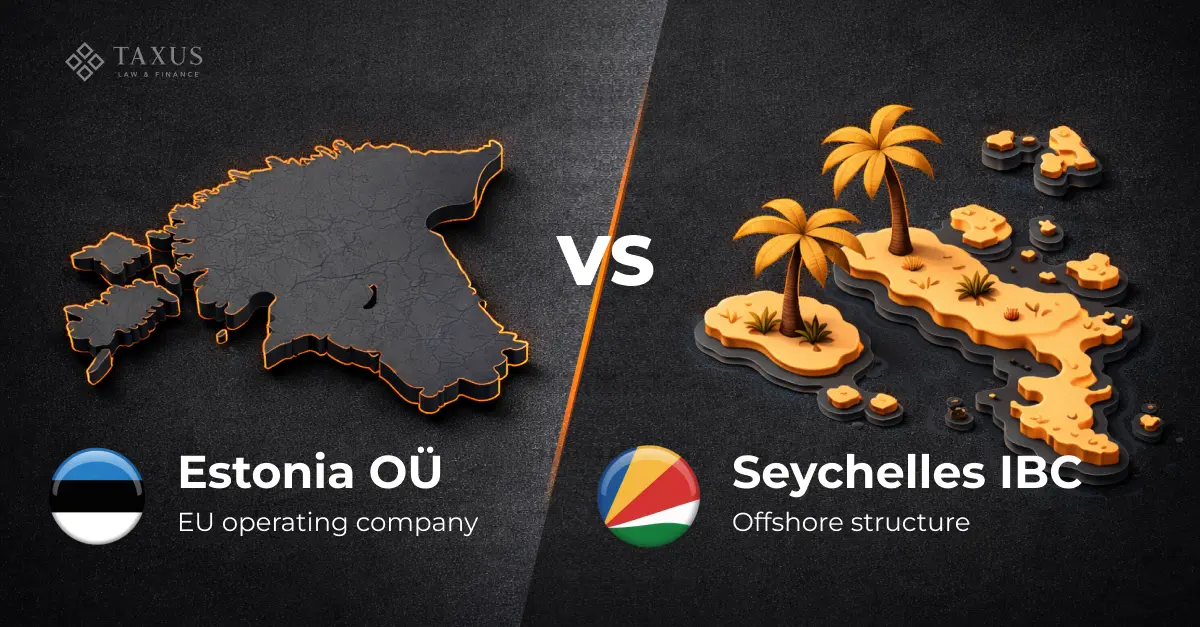


Today, Estonia is widely known as a “gold standard” for IT businesses worldwide. Transparent regulation, strong digital infrastructure, and a clear tax framework make an Estonia OÜ (Osaühing, a private limited company) an attractive option for most founders. However, for certain business models, full EU-level compliance can be unnecessary — or simply not cost-effective.
In that case, it makes sense to consider other options, focusing on a Seychelles IBC (International Business Company). In this article, we explain when a traditional Seychelles offshore company is a better fit than a European operating company, compare Seychelles company registration with Estonia OÜ across taxation, reporting requirements, and banking/PSP expectations, and share practical steps on how to set up a company in Seychelles — i.e., start Seychelles company formation when an offshore company Seychelles structure fits your goals.
Estonia OÜ vs Seychelles IBC: different tools for different goals
The key point to understand is the nature of the difference: an Estonia OÜ is an EU operating company built for active business, payments, and hiring — with a full reporting cycle — while a Seychelles offshore company (a Seychelles IBC) is a streamlined structure for more passive use cases that typically requires less administration, but comes with important nuances around banking access and reputation.
Seychelles vs Estonia company: who should you choose?
To help you quickly assess which jurisdiction fits your intended business model, we compared them across the key criteria.
| Criterion | Estonia OÜ (Private Limited Company) | Seychelles IBC (Seychelles company formation) | Comment |
| Taxation | 0% on undistributed profit. When dividends are paid: 22/78 (22% is corporate income tax; 78% is paid to shareholders). ⚠️ From January 1, 2025, the preferential 14% rate for regular dividends was also abolished. | 0% on income earned outside Seychelles (territorial principle). | Seychelles vs Estonia company: Estonia wins in transparency; Seychelles wins in having no tax on passive income earned abroad. |
| Reporting | Monthly (VAT/TSD) + annual report. Full bookkeeping required. | Requirement to maintain and store accounting records (via the agent). Annual Financial Summary filing. | Reporting is simpler in Seychelles, but record-keeping requirements are getting stricter every year. |
| Banking / PSP | High approval/acceptance rate. EMI options (Wise, Paysera) and traditional banks (LHV, Swedbank — if you have an Estonia nexus). | Challenging. Traditional EU banks are usually not available. Main options are offshore banks or more tolerant EMIs. | Set up a company in Seychelles is easy — opening a bank account is a separate quest. |
| Reputation (Blacklists) | “White” jurisdiction; member of the EU and OECD. | Removed from the EU blacklist (Annex I), but still appears on the EU grey list (Annex II). | Impacts transactions: payments to/from Seychelles may be subject to enhanced monitoring/compliance checks. |
| Transparency | Public register. Beneficial owner (UBO) data is publicly available. | Closed register for the public. UBO data is filed to a closed database (BO Database) via a registered agent. | If privacy matters (not to be confused with anonymity from regulators), Seychelles wins. |
| Substance | Demonstrable management in Estonia (office, staff, administration). | Shell-company without physical presence. | With an offshore company Seychelles, there’s a risk of being treated as tax resident in another country under Place of Effective Management rules if substance cannot be proven. |
| Double tax treaties (DTT) | Wide DTT network. Ability to apply reduced rates on withholding tax. | Weak DTT coverage. Most treaties do not apply to IBC-type companies. | Risk of Withholding Tax (15–30%): the payer country may withhold tax at source, and Seychelles’ zero tax rate won’t help. |
| Maintenance | Built from fixed monthly costs: virtual office, contact person, accounting. | Built from annual fees (Annual Renewal Fees) for the license and registered agent services. | Your choice: Estonia OÜ with regular operating costs vs Seychelles IBC with “hidden” legalization/onboarding costs. |

Need the right structure for your case?
When Estonia is the better choice (Seychelles vs Estonia company)
Choosing Estonia OÜ is usually the better option when reputation, straightforward banking, and having a real business presence in the European Union are critical — especially compared to a Seychelles IBC or a typical Seychelles offshore company structure (i.e., Seychelles company formation for offshore use cases).
1) Working with EU clients
Many EU counterparties have internal compliance rules that restrict cooperation with offshore jurisdictions. To sign contracts smoothly, you typically need a reliable partner with an EU VAT number and a company that can be easily verified in Estonia’s official business register. In practice, this is one of the clearest “Seychelles vs Estonia company” decision points.
2) Opening an operating office
If you plan to hire employees, rent office space, and run day-to-day operations with regular business expenses, Estonia gives you a strong framework to control these costs while reinvesting profits efficiently (thanks to Estonia’s corporate tax model). This is where Estonia OÜ vs Seychelles IBC differs dramatically: Estonia is designed for active operations, while an offshore company Seychelles is not. For more details, see our in-depth guide on Estonia for fintech projects.
3) Raising investment
Institutional investors and venture capital funds typically require a clear corporate governance framework and a predictable legal environment — which an EU jurisdiction provides. For most VC scenarios, Estonia is a far more standard (and audit-friendly) option than Seychelles company registration via an IBC model.
Want to explore Estonia as a business case in more detail and request a consultation to discuss your model? See: Estonia company registration with an EMI account.
Seychelles scenarios: when Seychelles company formation makes sense
Let’s look at four key areas where the Seychelles can be more efficient than many mainland jurisdictions — provided you understand the banking and compliance nuances of a Seychelles IBC (often referred to as a Seychelles offshore company).
1) Setting up a holding company or SPV (Special Purpose Vehicle)
This is the most traditional use case. Your Seychelles offshore company (a Seychelles IBC) becomes a “layer” above your actual operating company.
For example, you already run an active business in Ukraine or the EU. A Seychelles holding/SPV can be used to hold shares, consolidate ownership, or accumulate profits for reinvestment — while keeping the structure lightweight from an administrative perspective (with a registered agent and annual renewal).
2) Contract hub
A Seychelles company formation can act as the owner of intellectual property rights and receive royalty income under licensing agreements.
What matters is not only the contracts themselves, but also how the structure will look under tax residency, CFC rules, and modern compliance standards (KYC/KYB, bank/PSP onboarding). In other words: Seychelles company registration can work as an IP/contract hub, but it must be built with real business logic and proper documentation so it isn’t treated as a “sham” arrangement for tax purposes — especially given the substance/economic presence expectations introduced under the International Business Companies (Amendment) Act, 2020.
3) Risk separation
If you’re entering high-risk markets or testing a new product, it can be reasonable to isolate that activity in a separate legal entity — so you don’t put your core business at risk.
In practice, an offshore company Seychelles structure can be used to ring-fence operational, legal, or reputational risks (while the main company continues operating in a “white” jurisdiction).
4) Speed and administrative convenience
If you need speed, Seychelles is often more straightforward: you don’t have to wait for e-Residency or go through lengthy onboarding workflows typical for EU jurisdictions.
As a result, set up a company in Seychelles is usually faster, and ongoing maintenance can be cheaper than European alternatives — although banking/PSP access will still depend on your model, documents, and compliance profile.
Pitfalls of Seychelles company formation: banking, compliance, and reputation
When choosing a Seychelles offshore company (a Seychelles IBC), it’s important to factor in several risks driven by international regulation:
- The banking challenge. Opening an account with a classic “tier-1” bank is usually difficult for a Seychelles offshore company. In most cases, the realistic routes are EMIs/payment institutions or banks in other offshore-friendly jurisdictions (e.g., the Caribbean or Mauritius). In other words: set up a company in Seychelles can be fast, but banking (and PSP onboarding) should be planned separately.
- Estonia OÜ vs Seychelles IBC in day-to-day transactions. A payment originating from an Estonia OÜ is typically perceived as lower-risk, while payments involving a Seychelles IBC may trigger enhanced due diligence. Banks, EMIs, or counterparties can request additional KYC/KYB materials — and often ask for contracts and invoices to support each large transaction.
- Blacklists & grey lists. Even though Seychelles is no longer on the EU blacklist (Annex I), it remains on the EU grey list (Annex II) and is still under monitoring. For businesses, this usually means stricter compliance checks, more questions about the beneficial owner (UBO), and deeper scrutiny of the business model and source of funds.
To avoid wasting time on bank rejections, we recommend choosing a bank or PSP that works with your business model first — and only then registering the company. We’ve covered this earlier in our guide on how to choose the right offshore jurisdiction for your business model.
Do you really need a Seychelles offshore company?
Before you set up a company in Seychelles, answer these questions honestly. They will help you understand whether Seychelles company formation (a Seychelles IBC) is genuinely the right tool — or whether an Estonia OÜ (or another “white” jurisdiction) would work better for your goals.
10 control questions before Seychelles company registration
Holding/SPV, IP ownership, contract hub, risk separation — or active operations with hiring and EU clients?
If your revenue is mostly from the EU/UK, will your counterparties accept an offshore structure without additional compliance friction?
Do you have a realistic route to an EMI/PSP, and are you ready for enhanced KYC/KYB checks?
Banks and EMIs will ask for a transparent narrative, supporting documents, and a consistent flow of transactions.
If VAT registration is essential, Estonia OÜ vs Seychelles IBC becomes an easy choice in favor of Estonia.
A Seychelles offshore company may trigger additional checks, delays, or even outright rejections from some partners.
Some marketplaces, ad networks, and regulated businesses have internal restrictions on offshore jurisdictions.
Even if the company is tax-free in Seychelles, your home country may tax you under CFC rules and require reporting.
If the real decision-making is in another country, the company may be treated as tax resident there under the Place of Effective Management approach.
Seychelles IBCs still must keep accounting records, maintain corporate documentation, renew the company annually, and disclose UBO information to the registered agent’s closed database (where required).
Seychelles IBCs still must keep accounting records, maintain corporate documentation, renew the company annually, and disclose UBO information to the registered agent’s closed database (where required).
If most of your answers point toward EU clients, fundraising, regulated payment flows, and daily operations — Estonia is usually the better fit.
If your answers align with holding/SPV, IP ownership, limited transactions, and a clear compliance roadmap — a Seychelles IBC can work well.
Seychelles IBC setup: the high-level path
Treat Seychelles company formation as two parallel tracks: incorporation (fast) and banking/PSP readiness (often the bottleneck).
- Feasibility check first: confirm your model, counterparties, and expected payment flows won’t create immediate friction for an offshore company Seychelles structure. This prevents doing Seychelles company registration first and discovering later that onboarding is unrealistic.
- Incorporation basics: a Seychelles IBC is set up via a registered agent with a simple structure (name, roles, shareholding) and standard KYC/KYB for the UBO/key persons.
- Make it usable: prepare a clear business narrative and supporting documents (contracts/invoices), plus basic record-keeping and renewal planning.
- Banking/PSP: plan early and build an onboarding pack — it’s usually what determines timelines.

Frequently Asked Questions (FAQ)
1) Is a Seychelles IBC legal?
Yes. A Seychelles IBC is a standard legal form regulated under Seychelles corporate law. The key is how you use it: the structure must have a clear business purpose, proper documentation, and ongoing compliance (including maintaining accounting records and completing annual renewal).
2) Is a Seychelles offshore company really “tax-free”?
A typical Seychelles offshore company (Seychelles IBC) is generally taxed at 0% on income earned outside Seychelles. However, your personal or group taxation may still apply under tax residency rules and CFC rules in your home country. Always assess the full tax picture, not only the company’s local tax rate.
3) How long does Seychelles company formation take?
In most cases, Seychelles company formation can be completed quickly once the KYC documents are ready and the name is approved. The incorporation itself is usually faster than EU jurisdictions, but opening a bank/EMI/PSP account may take longer and should be planned separately.
4) Can I open a bank account for an offshore company Seychelles?
It’s possible, but it can be challenging. Many EU banks are reluctant to work with offshore jurisdictions. Common alternatives are EMIs/payment institutions or banks in more offshore-tolerant regions. A compliance-ready onboarding pack (KYC/KYB, contracts, invoices, source of funds) is often the deciding factor.
5) Do Seychelles IBCs need accounting and reporting?
Yes. Even though requirements are lighter than in Estonia, a Seychelles IBC must maintain and store accounting records and comply with corporate maintenance rules through a registered agent. Practical requirements vary depending on your activity and onboarding needs.
6) Are Seychelles on any EU lists?
Seychelles is not on the EU “blacklist” (Annex I), but it has been on the EU grey list (Annex II) and remains under monitoring. In practice, this affects compliance: counterparties and financial institutions may apply enhanced due diligence.
7) What’s better: Estonia OÜ vs Seychelles IBC?
It depends on your goals. Estonia OÜ is usually better for EU operations, VAT, hiring, fundraising, and smoother banking/PSP acceptance. A Seychelles IBC can be useful for holding/SPV, IP ownership, contract structuring, and risk separation — if you have a realistic banking strategy and understand tax residency/CFC implications.
Conclusion: Seychelles vs Estonia company — choose the tool that matches your business reality
There is no “universally best” jurisdiction — only the right structure for a specific scenario.
An Estonia OÜ is typically the stronger choice when you need an EU operating company: stable reputation, easier banking/PSP onboarding, VAT and day-to-day operations, hiring, and fundraising. In most active business cases, Estonia OÜ vs Seychelles IBC is a clear comparison in favor of Estonia.
If you’re considering Seychelles company formation, start with a compliance-first approach: validate the business model, map the banking/PSP route, and build the structure around real substance and a clear purpose. This is the fastest way to make Seychelles company registration work in practice — without surprises after incorporation.

Need a detailed cost estimate and a step-by-step registration plan?

Looking for a reliable payment processing system?
Order selection of a payment solution.