Trademark Registration Cost: What Businesses Actually Pay For



In today’s world, a brand is much more than just a catchy name or logo. It is one of the most valuable assets of a company. A brand affects recognition, customer trust, pricing, and ultimately profitability. However, without proper legal protection, a brand remains vulnerable. It may be copied, used by unfair competitors, or even registered by third parties in their own name.
Trademark registration is an investment in business security. At the same time, it is an investment with a very specific price. And that price varies significantly depending on the territory in which protection is sought.
However, official filing fees are only the beginning. The real cost of brand protection includes preliminary searches for similar marks, application preparation by a qualified specialist, handling possible refusals and responses to office actions, and, in complex cases, litigation. Very often, these “invisible” costs make up the largest part of the budget.
Before calculating the cost of trademark registration, it is important to understand what may happen if a brand remains unprotected. We explain the key legal and commercial risks in our article on 7 risks your business faces without trademark registration.
In this article, we will look at what trademark registration cost actually includes, which hidden expenses businesses should consider, what factors influence the final price, and how costs can be optimized without putting brand protection at risk.
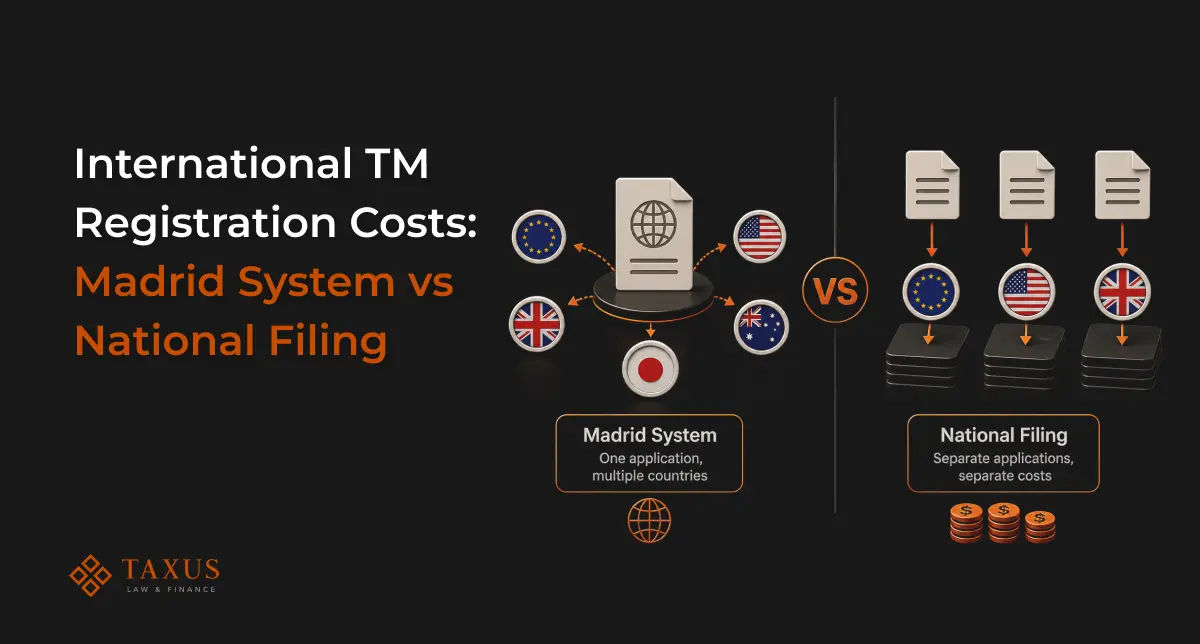
This article is part of our series on trademark registration costs. If you want to compare official filing fees in specific jurisdictions, read our guide on Trademark Registration Fees in the EU, US and UK: Official Costs Compared. If your business plans to protect a brand in several countries, see our article on International Trademark Registration Costs: Madrid System vs National Filing.

Need to understand how much trademark registration may cost for your brand?
What Does Trademark Registration Cost Include?
Trademark registration cost usually consists of several elements. The most obvious part is the official filing fee paid to the relevant trademark office. However, this is only one part of the total budget.
In practice, businesses should also consider:
- preliminary trademark searches;
- application preparation;
- proper classification of goods and services;
- attorney fees and professional costs;
- handling possible refusals or office actions;
- opposition risks;
- trademark watch services;
- renewal fees.
The final cost depends on where the application is filed, how many classes are selected, what type of trademark is registered, and whether additional legal support is needed during the process.
Official Filing Fees vs Attorney Fees
Trademark registration is not only about paying official fees. It is also a process that requires accuracy, knowledge of legislation, and an understanding of risks. That is why most companies seek assistance from lawyers specializing in intellectual property.
Filing an application independently may seem like a cost–saving solution, but mistakes at the preparation stage often lead to refusals, the need to refile applications, missed deadlines, or even oppositions from competitors. Professional assistance helps avoid these issues and significantly increases the chances of successful registration.
Lawyers assist at all stages:
- analysis of the trademark and assessment of its registrability, including whether it is descriptive, generic, or too similar to existing marks;
- proper classification of goods and services under the Nice Classification, which is one of the common grounds for refusal;
- preparation of the application, including drafting the description, selecting the correct classes, and filing documents;
- support throughout the process, including responding to office actions, remedying objections, and defending against potential oppositions.
Without an experienced specialist, it is easy to overlook nuances that may seem minor, for example incorrect wording in the specification, but these are often the reasons for refusal.
It is especially important to seek professional assistance if the trademark contains non–standard elements, such as a logo, slogan, colors, or 3D elements, or if registration is planned in several classes. This increases both complexity and risk.
Hidden Trademark Costs Businesses Often Miss
In addition to official filing fees and attorney fees, applicants should also consider several expenses that are not always obvious at the beginning.
Trademark Clearance Search
Before filing an application, it is recommended to conduct a thorough clearance search for similar registered and unregistered marks.
This allows applicants to:
- identify potential conflicts before filing;
- assess the likelihood of successful registration;
- avoid wasting time and resources on a trademark that is highly likely to be refused or challenged.
A trademark clearance search adds to the initial budget, but it often helps avoid significantly higher expenses later, especially if the mark is refused or opposed.

Trademark registration costs can increase if the application is filed without a proper search or with incorrectly selected classes.
Trademark Watch Services
After registration, or even during the registration process, it is useful to set up trademark watch services to monitor newly filed applications for similar marks.
This allows trademark owners to:
- learn about potential threats in a timely manner;
- file oppositions within the relevant publication window;
- protect their rights against copying or dilution of the brand.
Without such monitoring, a company may miss an attempt by a competitor to register a very similar trademark, which may later lead to costly disputes.
Additional Expenses
Additional expenses may also arise if the applicant wants to accelerate the process, file in several jurisdictions, respond to objections, or handle opposition proceedings.
In many jurisdictions, expedited or fast–track procedures may shorten examination or publication timelines. However, such procedures often require a carefully prepared application and proper drafting of the specification of goods and services.
Therefore, even when the official filing fee is clear, the overall cost of trademark protection may increase because of additional procedural steps, legal review, or the need to correct mistakes.
What Affects the Final Cost?
Several factors influence the final trademark registration cost. The most important are the number of Nice classes, the type of trademark, and the chosen filing strategy.
Number of Nice Classes Chosen
One of the key factors that directly affects the cost of trademark registration is the number of selected classes under the Nice Classification of Goods and Services. Each class covers separate categories of goods or services for which the applicant seeks legal protection.
In most jurisdictions, the basic official fee includes only one class, while each additional class requires payment of a separate fee.
Therefore, the broader the list of goods or services to be covered by legal protection, the higher the total cost of trademark registration.
Choice of Trademark Type
The cost and complexity of the procedure are also affected by the type of trademark the applicant intends to register. The most common types are:
- word mark;
- figurative mark or logo;
- combined mark.
Formally, official fees in many jurisdictions usually do not depend on the type of trademark. However, in practice, the type of trademark may affect associated costs.
For example, figurative and combined marks often require:
- professional preparation of graphic materials;
- additional legal analysis regarding similarity;
- searches in specialized image databases;
- a broader scope of examination.
In addition, word marks generally provide broader legal protection, since they protect the wording itself regardless of the style in which it is presented.
Word Mark vs Logo: Does the Cost Differ?
In many jurisdictions, it is not necessarily cheaper to register a logo than a word mark, or vice versa. The basic official filing fee is often the same regardless of whether the applicant files a word mark, a logo, or a combined mark.
However, associated costs may differ.
A word mark protects the wording itself and is often broader from a legal protection perspective. A logo or combined mark may be important where the visual identity of the brand plays a major role, but it may also require additional preparation and analysis.
For example, logo registration may involve additional costs connected with graphic materials, image similarity checks, and future rebranding. If the logo changes significantly, the business may need to consider filing a new application.
Therefore, the decision should not be based only on the filing fee. It should depend on the brand strategy and the type of protection the business needs.
How to Reduce Trademark Registration Costs
Trademark registration is an important investment in protecting a brand and the commercial reputation of a business. However, even where official filing fees are clearly established, the overall cost of trademark protection may increase significantly due to additional expenses, filing mistakes, or an incorrectly chosen registration strategy.
That is why effective trademark budget planning allows applicants not only to reduce costs but also to avoid future legal risks associated with refusals, appeals, or the need to refile applications.
Conduct a Knockout Search Before Filing
One of the most effective ways to reduce potential costs is to conduct a preliminary trademark search, or knockout search, before filing the application.
Such a search allows applicants to:
- check for identical or similar trademarks;
- identify potential conflicts with already registered brands;
- avoid opposition proceedings and legal disputes in the future.
In practice, refusal of registration or objections often lead to significantly higher costs than the price of the preliminary analysis itself.
Limit the Number of Nice Classes Wisely
Another important cost–optimization tool is the proper selection of classes under the Nice Classification. Each additional class increases:
- official filing fees;
- the scope of legal review;
- the risk of objections;
- the complexity of further trademark maintenance.
That is why applicants should register a trademark only for those goods and services that are actually in use, planned for use in the near future, or have real commercial significance for the business.
An excessively broad list of classes not only increases costs but may also create additional legal risks. In many countries, a trademark may be partially or fully cancelled due to non–use in relation to certain goods or services.
Choose Standard Filing Timelines When Possible
In many cases, applicants try to accelerate the trademark registration procedure as much as possible. However, expedited procedures or fast–track filing are not always economically justified.
The standard filing procedure is often less risky, more flexible if amendments are needed, and sufficiently fast for most business purposes.
At the same time, expedited procedures often require a perfectly prepared application, the use of standard specifications of goods and services only, additional legal review, and rapid responses to office actions.
For small and medium–sized businesses, standard filing timelines usually help avoid unnecessary expenses without significantly affecting business operations.
Fast–track procedures are generally advisable mainly in cases of:
- launching a new product;
- entering an international market;
- participating in major investment transactions;
- the need to quickly protect a brand from competitors.
Plan Trademark Renewals Early to Avoid Late Fees
Many companies focus exclusively on the initial stage of trademark registration and underestimate the importance of timely renewal. In most jurisdictions, a trademark remains valid for 10 years and may be renewed upon payment of renewal fees.
Failure to renew on time may result in:
- late renewal fees;
- loss of trademark rights;
- the need to re–register the trademark;
- the risk of registration of a similar brand by competitors.
Therefore, renewal deadlines should be planned in advance as part of the overall trademark budget.
FAQ
How much does trademark registration typically cost for a startup?
The cost of trademark registration for a startup depends on the jurisdiction, the number of Nice Classification classes, and the type of trademark.
Are trademark filing fees refundable if registration is rejected?
No, in most cases, trademark filing fees are non–refundable, even if the application is refused, registration does not take place, or the applicant voluntarily withdraws the application after payment.
Does trademark renewal cost less than initial registration?
No, renewal costs may be approximately the same as the initial trademark filing, depending on the jurisdiction and the number of classes.
Is it cheaper to register a logo or a word mark?
In many jurisdictions, the basic filing fees are generally the same regardless of the type of trademark. However, associated costs may increase for logo registration, for example in connection with graphic preparation, similarity searches, or rebranding.
Why can trademark registration cost more than the official filing fee?
Because the official fee is only one part of the total cost. The real cost may also include trademark searches, attorney fees, application preparation, responses to objections, oppositions, monitoring, and renewals.
How can a business reduce trademark registration costs?
A business can reduce costs by conducting a preliminary search before filing, selecting Nice classes carefully, avoiding unnecessary expedited procedures, and planning renewal deadlines in advance.

Protect your brand before competitors do

Looking for a reliable payment processing system?
Order selection of a payment solution.