EMI vs PSP vs Bank: How Businesses Should Structure Payments in the EU

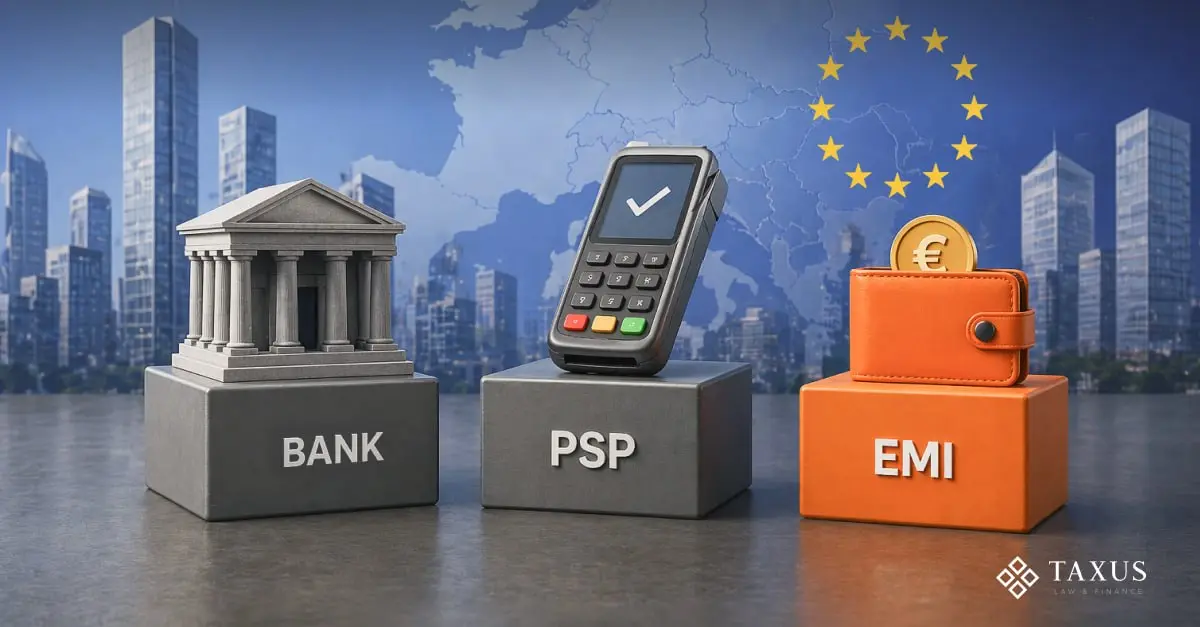


Within the European Union payment ecosystem, banks, payment service providers (PSPs), and electronic money institutions (EMIs) perform different functions, even though they may appear similar at first glance. For businesses, these differences usually become apparent not at the onboarding stage, but much later — when transaction volumes increase, geographic reach expands, or regulatory requirements become more stringent.
Understanding the role of each participant makes it possible to build a payment model that remains stable not only at launch, but also throughout scaling. In 2026, payments are increasingly moving beyond the simple question of “where to open an account” and becoming an integral part of overall business strategy.
1. Bank: When Stability, Control, and Traditional Financial Instruments Are the Priority
Banks are traditionally associated with a high level of reliability and predictability. They operate within a strict regulatory framework, hold client funds on their own balance sheets, and provide access to classical financial instruments. These include credit lines, overdrafts, bank guarantees, letters of credit, working capital financing, as well as tools for liquidity management and currency risk mitigation.
Such instruments are critical for manufacturing companies, distributors, logistics operators, construction businesses, as well as holding structures and professional services firms, where financial discipline and access to credit play a key role.
A typical business scenario involves using a bank account as the foundation of the financial structure. At an early stage, this approach rarely causes difficulties, especially when operations are limited to a single jurisdiction and a standard business model. However, as transaction volumes grow or cross-border payments emerge, banks begin to conduct deeper risk profiling of the company. This may result in additional checks, document requests, or temporary restrictions on access to funds.
Another important factor is the onboarding process itself. Some EU banks still do not support fully remote account opening or require the physical presence of directors or beneficial owners. For international teams, startups, or businesses with distributed structures, this significantly limits the range of banks that are practically accessible.
As a result, while banks provide a solid financial foundation, their conservative approach does not always align with the needs of businesses operating dynamic, international, or non-standard payment flows.
2. PSP: Payment Acceptance and a Focus on Customer Experience
Payment service providers are typically used to solve a specific operational task — accepting payments from customers. They allow businesses to quickly integrate card payments and local payment methods, optimize checkout processes, and reduce friction for end users.
PSPs are a core component for e-commerce, online education, subscription services, digital platforms, mobile applications, marketplaces, and any businesses focused on high-volume B2C or B2B2C traffic. Speed, conversion rates, and customer convenience are critical in these models.
In a typical setup, a business actively works with a PSP, payments are processed smoothly, and it may appear that the payment function is fully covered. In practice, however, PSPs have inherent limitations. They are not designed for long-term fund storage, may support a limited range of currencies or countries, and often apply strict internal policies toward certain risk profiles.
Even when everything appears to function well, a PSP may not fully support the entire business model — for example, by not covering specific regions, local payment methods, or certain transaction types. In addition, changes in internal policies or risk appetite can lead to delayed or suspended payouts without any actual violations on the business’s side.
PSPs are an effective tool for payment acceptance, but they should not be viewed as the sole or foundational element of a business’s payment infrastructure.
3. EMI: Balancing Regulation and Operational Flexibility
Electronic money institutions occupy an intermediate yet strategically important position between traditional banks and payment service providers. They operate under EU financial regulation but were originally designed to support digital and cross-border business models that do not easily fit into traditional banking frameworks.
The key distinguishing feature of EMIs lies in how client funds are held. Unlike banks, EMIs do not keep client funds on their own balance sheets. Instead, they are required to safeguard funds on segregated accounts held with partner banks. For businesses, this provides a higher level of transparency and reduces the risk of fund loss in the event of issues at the institution itself. This safeguarding structure often makes EMIs a suitable solution for companies handling large volumes of client funds or processing third-party payments.
In practice, EMIs are frequently used as operational hubs for financial flows. This is particularly relevant for fintech companies, SaaS platforms, marketplaces, IT outsourcing firms, affiliate networks, digital agencies, and international corporate groups operating across multiple EU jurisdictions. Multi-currency accounts, fast SEPA transfers, mass payouts to counterparties, and the ability to work across jurisdictions make EMIs a convenient tool for scaling without the constant need to open new bank accounts.
At the same time, EMIs are not a full replacement for banks. They do not provide lending, issue bank guarantees, or participate in traditional trade finance instruments. Their stability is directly linked to the quality of their correspondent banking relationships. If an EMI relies on a limited number of banking partners or has a weak safeguarding structure, this may affect the speed and reliability of transactions.
For this reason, when selecting an EMI, it is critical to assess not only the existence of a license, but also the operational model: which banks hold the safeguarding accounts, how many correspondent channels are used, how AML procedures are structured, and whether the institution is capable of supporting the business during growth. For companies with international or digital business models, EMIs often become the central element of payment architecture — provided the underlying infrastructure is properly designed.

Regulatory Context and Payment Resilience
All participants in the EU and global payment ecosystem — banks, PSPs, and EMIs — operate within AML, KYC, and data protection requirements. For businesses, this means that payment models must be prepared for change: new jurisdictions, new customer types, or increasing transaction volumes.
It is precisely at these moments that it becomes clear that different parts of a business model require different accounts and payment solutions. A single provider is rarely capable of effectively covering all scenarios — from payment acceptance to operational payouts, cross-border settlements, and liquidity management.
In practice, a payment chain is increasingly common: PSPs for accepting funds, EMIs for operational and multi-currency flows, and banks for fund storage and financial instruments. The earlier a business begins to build such a structure, the easier it becomes to scale without disruptions or forced changes.
Conclusion
Rather than viewing banks, PSPs, and EMIs as mutually exclusive options, businesses in 2026 are increasingly facing a different reality: different parts of a single business model require different types of accounts and payment solutions. One account or one provider rarely covers all scenarios — from receiving customer payments to operational payouts, cross-border transactions, and liquidity storage.
In practice, this means building a payment chain: for example, accepting payments through a PSP, using EMI accounts for multi-currency operational flows, and maintaining separate bank accounts for fund storage, counterparties, or financial instruments. Such a structure does not complicate operations — on the contrary, it allows risks to be distributed, reduces dependency on a single provider, and enables adaptation to change without interrupting business activity.
The earlier a company starts viewing payment architecture as a system rather than a set of isolated connections, the more comfortable it becomes to operate while scaling, entering new markets, and adapting to regulatory changes. A well-designed combination of accounts across different financial institutions forms the foundation for stable and controlled business growth.
👉 The Taxus Law&Finance team helps businesses analyze their business and payment models, structure relationships with banks, PSPs, and EMIs, and build payment infrastructures that remain stable through growth, regulatory change, and long-term market expansion.
Frequently Asked Questions (FAQ)
Can a payment model be built around a single provider?
In practice, no. A single bank, PSP, or EMI rarely covers all payment scenarios — from payment acceptance to operational and cross-border settlements. This is why companies increasingly build payment structures involving multiple institutions, each fulfilling a specific role.
How safe is it to store funds with an EMI?
EU-licensed EMIs are required to safeguard client funds on segregated accounts held with partner banks. This ensures that client funds are separated from the institution’s operational funds and protected under European regulatory requirements.
When should a business start considering additional payment accounts?
Ideally, before active scaling begins. Planning market expansion, increasing transaction volumes, or more complex business models in advance allows payment architecture to be built without urgency and helps avoid account restrictions at critical growth stages.у.

Looking for a reliable payment processing system?
Order selection of a payment solution.
Similar articles