Why accounts get blocked after onboarding and how to avoid it?

A. Hembar-Tabakova
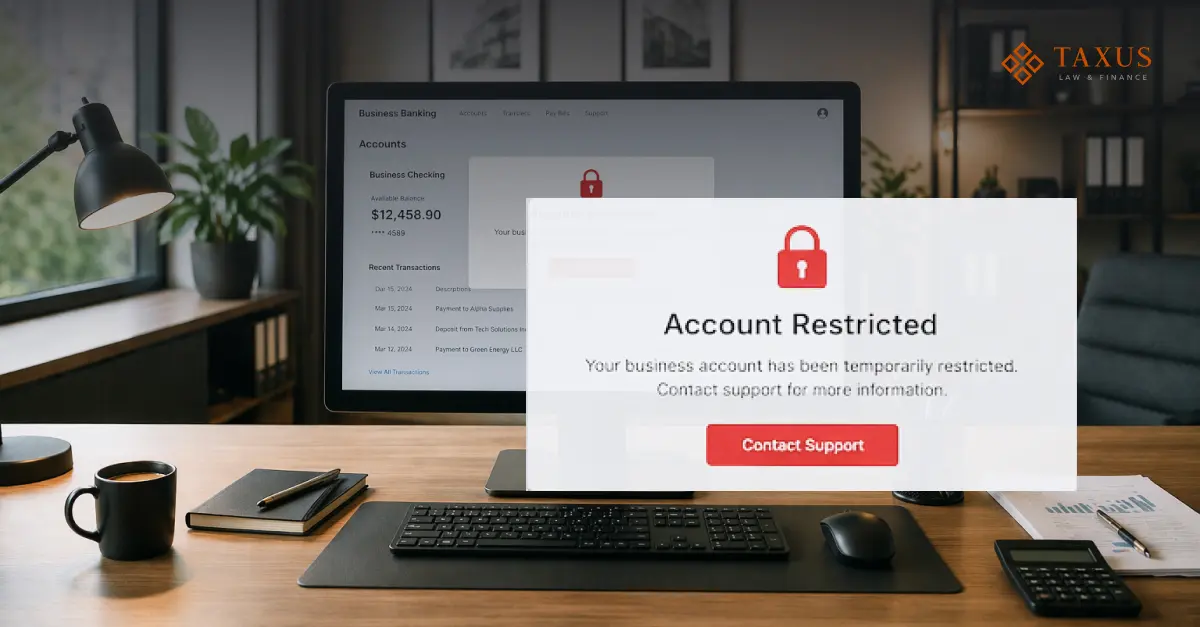


In 2025–2026, the approach of financial institutions to business risk assessment has changed significantly. Opening an account is no longer perceived as the final point of interaction between a business and a bank or payment institution — it is only the beginning.
Even if a company successfully passes initial onboarding and receives approval, the real risk assessment starts after operational activity begins. The actual behaviour of the account during the first weeks of operation shapes the client’s ongoing risk profile.
Financial institutions increasingly focus not on the declared business model, but on how the account is used in practice: how payment flows look, how stable they are, and whether they align with the institution’s expectations and declared parameters. As a result, account blocks and temporary freezes most often occur not at the account opening stage, but after the first transactions have already been processed.
These trends indicate a shift from formal compliance to continuous monitoring. In 2026, risk scoring becomes an ongoing process, where each stage of business activity directly affects the relationship with the financial institution.
👉 In the following sections, we will explore why accounts are blocked after approval and account opening, what exactly is analysed during post-onboarding checks, and which signals most often trigger freezes.
If you are planning to launch or scale your payment infrastructure, we can help you select a financial institution aligned with your business model, structure payment flows correctly, and reduce blocking risks before operations even begin.

1. Post-Onboarding Monitoring: how banks assess risk after account opening
Even after a business account is successfully opened, the financial institution continues to assess risk. In 2026, post-onboarding monitoring has become standard practice for banks, EMIs, and PSPs. This means that not all risk is addressed at the account opening stage — much of it emerges through real transaction activity.
In practice, most account blocks are not caused by a single “critical mistake,” but by the accumulation of smaller inconsistencies that become visible only after the account goes live. These signals activate post-onboarding monitoring and place the account under enhanced scrutiny.
Key triggers affecting post-onboarding risk scoring include:
Transaction patterns
- A sudden increase in volumes, unusual transaction amounts, atypical payment frequency, or heavy concentration on one customer type — especially when these deviate from the expected business plan — are often interpreted as signals requiring manual review.
- For example, some European PSPs have blocked client accounts after actual transaction volumes exceeded projections by more than 30%.
Traffic and counterparty geography
- Banks, EMIs, and PSPs closely monitor the origin of payments. If a company declares certain customer countries during onboarding but transactions later originate from unapproved GEOs, this is one of the strongest risk flags.
- Traffic from the United States, Latin America, India, or the Philippines is often classified as high-risk.
- European regulators (EBA, FCA) recommend enhanced due diligence for operations involving high-risk jurisdictions. For a broader overview of freeze triggers in high-risk payment processing, see our guide on high-risk merchant accounts, where we explain how traffic geography, chargebacks, and KYB gaps affect account stability.
User behaviour and chargebacks
- A high chargeback rate (>1–2%) or a large number of refunds over a short period triggers additional screening.
- Even if formal thresholds are not exceeded, negative early-stage dynamics may lead to temporary holds or payout restrictions.
- According to FCA data (2025), 30% of account blocks in the high-risk segment are linked to mismatches between actual and expected chargeback profiles.
Inconsistencies in documents or company structure
- Changes in the business model or UBO after approval without updating KYB/KYC documentation are direct freeze triggers.
- The EBA Guidelines on AML/CFT (2023) explicitly require banks to continuously verify the accuracy and consistency of customer information.
Suspicious or unusual activity
- Large volumes of repetitive transactions, unusual volume spikes, shifts in customer behaviour patterns, new products, changes in monetisation models, introduction of subscriptions, or changes in marketing channels without prior notification are common freeze scenarios.
- Such activity is automatically flagged due to AML and fraud prevention regulatory requirements.
Weak or insufficient communication with the bank / PSP
Another often underestimated cause of account blocks is ignoring requests from the payment institution or providing formal, incomplete responses. After account opening, banks may request additional documents, clarifications on specific transactions, or updated information on clients, partners, or geography.
Problems arise when:
- responses are delayed
- information is fragmented or contradictory
- the client underestimates the seriousness of the request and responds superficially
In these cases, the bank often concludes that the client is either unwilling to cooperate transparently or is concealing risks.
The result is an elevated risk profile, operational restrictions, or full account closure without detailed explanations.
These factors explain why blocks and freezes often occur weeks or months after account launch rather than immediately.
Important: account blocks are rarely “punitive.” In most cases, they are preventive measures while the financial institution seeks to understand the true risk profile of the business.
2. How to operate a business account after launch to avoid blocks
After opening an account, the main risk for a business is treating it as static and “approved once and for all.” In 2025–2026, financial institutions view accounts as dynamic risk profiles that are continuously reassessed based on actual business behaviour.
To maintain account stability, providers expect a controlled and predictable operational approach rather than a passive stance. In practice, this comes down to several key post-launch actions.
- Regular synchronisation with the financial institution
Banks and payment providers expect businesses to proactively communicate changes: new markets, pricing updates, marketing channels, or client structure shifts. Proactive communication significantly reduces the likelihood of sudden freezes or restrictions. - Monitoring transaction behaviour
Even “acceptable” metrics can become problematic if their dynamics change. Stability is more important than rapid growth — especially during the first months after launch. - Keeping KYC/KYB and corporate data up to date
By 2025, periodic reviews had become standard practice. Outdated documents, as well as changes in the company structure, management, or beneficial owners without notifying the provider, create additional risk and may become a formal trigger for restrictions. - Internal processes and accountability
The most stable cases are those where responsibility for payment infrastructure is clearly assigned to a specific person or team. When oversight is fragmented across legal, finance, and operations, risks increase.
In short, financial institutions value predictability and control. Businesses that appear transparent, structured, and logical in their operations face fewer restrictions — even in high-risk segments.
In the next section, we will address what to do when a block does occur and how to resolve it efficiently without losing the account.
3. What to do if an account has already been blocked
An account block after onboarding is often perceived as the end — especially when payments are halted and support responses are generic or absent. In reality, many cases represent not the end of cooperation, but a signal that the bank or PSP has identified a risk that can (and should) be addressed properly.
Before discussing next steps, it is important to clarify terminology.
Freeze temporary restriction is a preventive measure where account operations are limited while the provider conducts additional checks. Typically:
- incoming funds may be credited but not withdrawn, or
- all transactions are temporarily suspended;
- the provider requests explanations, documents, or an updated KYB package.
Block / closure is a final decision to close the account, usually applied when:
- the risk is confirmed or cannot be explained;
- the actual business model differs materially from the declared one;
- contractual or regulatory requirements are breached.
The distinction is critical: a freeze can often be resolved, while a closure requires preparing alternative solutions and an exit strategy.
What not to do
Initial reactions matter. Certain actions only worsen the situation:
- ignoring requests or delaying responses;
- emotional communication, appeals to “unfairness,” or business urgency;
- pressuring support to unblock the account without explanations;
- sending documents chaotically without structure or context.
For compliance teams, this signals lack of control and unwillingness to cooperate.
What actually works in practice
If the account is frozen, recovery is often possible. However, successful unfreezing is not achieved through a single email — it requires a structured process addressing specific risks.
1. Root cause analysis
Identify the true reason for the block:
- mismatch between transactions and declared model;
- counterparty or traffic issues;
- outdated or incomplete KYB information;
- geographic or product-related risks.
Without this, explanations will miss the mark.
2. Aligning data
All data must once again form one coherent and logical picture:
- business model ↔ actual transaction flows;
- clients ↔ acquisition channels;
- agreements ↔ real operations.
Any discrepancies should either be clearly explained or eliminated.
3. KYB refresh
Blocks often trigger a renewed business review. KYB updates may include:
- updated corporate documents;
- revised activity descriptions;
- group, partner, and beneficiary structures;
- explanations of changes since onboarding.
This is standard practice, not a penalty.
4. Traffic cleanup
If payments or clients are the issue, it may be necessary to:
- disable high-risk traffic sources;
- restrict certain jurisdictions;
- adjust payment descriptions;
- revise client onboarding procedures.
Compliance teams need to see that risk is controlled, not ignored.
When unfreezing is realistic
Chances are high if:
- the business is real and transparent;
- the block reason is identified and resolved;
- communication is clear, structured, and timely;
- the client shows readiness to adapt to PSP requirements.
In such cases, the account may be fully or partially restored.
When to prepare a backup solution
Sometimes realism is required. Preparing an alternative solution in parallel is advisable if:
- the risk profile does not align with the institution’s policy;
- the business model cannot accommodate required compromises;
- the block is final and non-reviewable.
A backup solution is not a failure — it is a core part of payment risk management strategy, especially for international or high-risk businesses.
4. How We Handle Such Cases
We regularly encounter situations where accounts are blocked after onboarding or flagged as high-risk. Our approach is proactiverather than reactive.
Pre-launch risk review
Before account opening or flow activation, we analyse the business model, geography, client types, and potential triggers against the compliance frameworks of specific PSPs.
Alignment before first transaction
We help align declared onboarding data with real transactional behaviour to ensure that first payments do not surprise the financial institution.
Support during the post-onboarding phase
After launch, we support communication with PSPs, assist with explanations, KYB updates, and flow adjustments when requests or flags arise.
This approach reduces block risks and makes cooperation with payment institutions more predictable — even in high-risk scenarios.
5. Frequently Asked Questions (FAQ)
Why can an account be blocked without prior notice?
Most blocks are triggered by automated risk signals: sudden volume changes, unexpected geographies, undeclared flows, or abnormal customer behaviour. Warnings are not always issued, especially if the system classifies the risk as high.
Does a block mean the business is blacklisted?
Not necessarily. In most cases, the decision is local to a specific PSP. However, repeated unexplained blocks may negatively affect future onboarding.
Is it possible to unfreeze an account after a freeze?
Yes, if the cause is identified and resolvable. The highest chances occur when the business provides clear explanations, updated KYB, and aligns actual flows with the declared model.
Can post-onboarding blocks be completely avoided?
No, but they can be significantly reduced. Key factors include accurate business descriptions, consistency between declared and real transactions, transparent corporate structures, and readiness to respond quickly to compliance requests.
How long does unfreezing usually take?
Timeframes depend on the freeze cause and the business’s preparedness. On average, from a few days to 2–3 weeks. Clear, structured communication significantly shortens this process.
6. Conclusion: Onboarding Is the Beginning, Not the Finish
Onboarding is often seen as the main goal: once the account is opened, risks are considered resolved. In reality, payment infrastructure works the opposite way.
High-risk processing is an ongoing process, not a one-time check. Risk does not disappear after approval — it transitions into a monitoring phase focused on real transactions, clients, and business behaviour.
In this context, transparency matters more than a “perfect profile.” Banks and PSPs are willing to work with risk if it is understood, declared, and managed. Hidden changes, unexpected flows, or grey areas almost always lead to flags and blocks.
Ultimately, PSPs value predictability, not surprises. Clear business logic, controlled flows, and readiness for compliance dialogue are the foundations of long-term stability.
Stable processing does not start with account opening — it starts with a well-structured payment strategy.

Ready to minimise blocking risks and scale your business with confidence?

Looking for a reliable payment processing system?
Order selection of a payment solution.
Similar articles