Seychelles Jurisdiction in 2026: The Evolution of an Offshore Hub and Its Role in International Structures

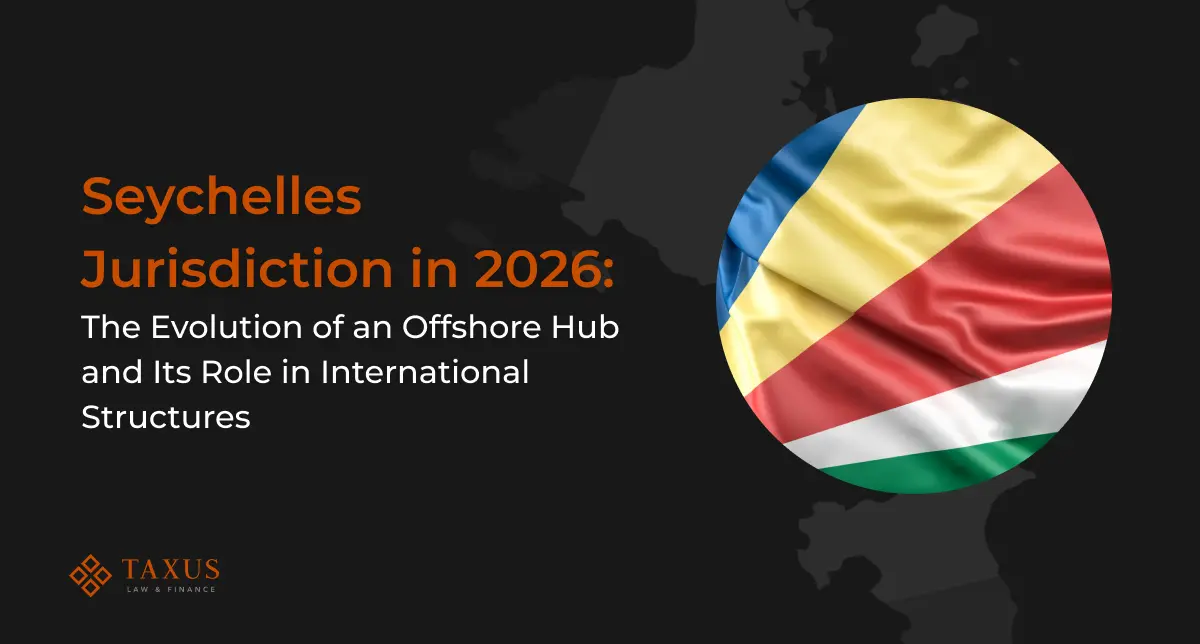


Over the past few years, the Seychelles jurisdiction has undergone a significant transformation. Previously perceived as a classic offshore with minimal requirements, it has now evolved into a more structured and internationally aligned regulatory environment.
These changes are driven by the requirements of international organizations, particularly the OECD and the Financial Action Task Force (FATF), which continue to strengthen standards on transparency, anti-money laundering, and tax compliance.
As a result, the Seychelles International Business Company (IBC) remains a popular vehicle for international structuring, but the rules governing its use have become much clearer. Today, business owners must understand how compliance, transparency, and economic substance requirements have evolved.

Considering Seychelles for your international structure?
Top 5 Compliance Changes That Actually Impact Structures
Below are five key developments that have had the most practical impact on the use of Seychelles IBCs in international structures.
Economic Substance
One of the most significant reforms in Seychelles has been the introduction of economic substance requirements – i.e., the obligation to demonstrate real business activity and management aligned with the income generated.
These rules were introduced following amendments to tax legislation under the Business Tax (Amendment) Act 2020, with practical implementation starting on 15 September 2021. The reform forms part of a broader global initiative to enhance tax transparency in line with OECD standards. Its core objective is to ensure that companies benefiting from the jurisdiction’s tax regime have genuine economic activity and a valid business rationale, rather than merely a formal legal presence.
What does this mean in practice?
From a practical standpoint, companies are expected to:
- demonstrate real management and control of their activities;
- confirm that key business decisions are made at the company level;
- maintain sufficient resources or operational activity linked to income generation.
If a company fails to meet economic substance requirements, its foreign-sourced income may become taxable in Seychelles.
In essence, the jurisdiction has shifted from a purely territorial tax model to a more hybrid approach, where the substance and reality of business operations play a critical role.
Who do these rules apply to?
Economic substance requirements do not automatically apply to all Seychelles IBCs. They primarily target companies that are part of multinational groups (MNEs) or derive passive income from abroad – such as dividends, interest, royalties, or income from asset exploitation.
Such entities may qualify as “covered companies” and must demonstrate adequate economic presence. By contrast, many standard IBCs engaged in international trade or service provision outside Seychelles are subject to significantly lighter requirements.
Key business implications
The introduction of economic substance has fundamentally changed how Seychelles structures are used. Companies must clearly articulate their business model, substantiate income sources, and be prepared for scrutiny from registered agents, banks, and payment providers.
As a result, Seychelles is no longer suitable for purely passive offshore structures, but it remains effective for international businesses with transparent operations and proper compliance.
Strengthened AML / KYC and Due Diligence
As part of enhanced financial transparency requirements, Seychelles has significantly tightened AML (Anti-Money Laundering) and KYC (Know Your Customer) procedures.
In line with legislation and FATF recommendations, client due diligence is performed not only by banks and payment institutions but also by registered agents, through whom Seychelles IBCs are incorporated. In practice, the registered agent conducts the initial review of beneficial owners, ownership structure, source of funds, and the nature of business activities.
During the KYC process, clients may be required to provide a broad range of documents, including:
- proof of identity and residential address;
- information on source of funds or income;
- declaration of non-PEP (politically exposed person) status;
- in certain cases, a criminal record certificate or additional business-related documentation.
Where ownership structures are complex or the business involves higher risk, Enhanced Due Diligence (EDD) is applied.
Importantly, a registered agent may refuse to incorporate a company if the due diligence results raise concerns – for example, due to unclear source of funds, high-risk activities, sanctions exposure, or reputational risks.
The same compliance logic applies at the banking and EMI onboarding stage. To understand what can go wrong, see our article on why business account applications get rejected and how to avoid common mistakes.

KYC issues can delay or block incorporation
Increased Tax Transparency and CRS
Another major development is the enhancement of tax transparency and Seychelles’ participation in the Common Reporting Standard (CRS) – the international framework for the automatic exchange of financial account information.
Under CRS, financial institutions report information on accounts and beneficial owners to tax authorities, which may then exchange this data with other jurisdictions.
This has also changed the practical interpretation of the “0% tax” concept for Seychelles IBCs. While companies conducting business outside Seychelles may still benefit from zero corporate tax locally, this does not imply tax anonymity or absence of reporting obligations. Company owners may still be subject to tax residency rules in their home jurisdictions.
In practice, CRS means that banks, payment providers, and financial institutions conduct deeper analysis of corporate structures, beneficial ownership, and tax residency. As a result, Seychelles IBCs today operate under a much higher level of transparency and compliance compared to traditional offshore models.
Clear Focus on Non-EU Business
Following regulatory reforms, Seychelles has gradually established a clear niche as a jurisdiction for international businesses operating primarily outside the European Union.
Such structures are commonly used for international trade, holding activities, asset management, or intra-group operations, where the core business activity takes place in other regions.
In these models, Seychelles can be efficient due to its flexible corporate framework, absence of currency controls, and relatively simple governance structure. However, companies must still comply with standard compliance procedures and demonstrate a valid business rationale.
At the same time, Seychelles does not effectively compete with EU jurisdictions. Businesses targeting European clients, venture investment, or cooperation with EU financial institutions typically opt for EU-based structures, driven by banking, regulatory, and substance requirements.
If you are choosing between an offshore structure and an EU company, we also recommend reading our comparison of Seychelles Company Formation vs Estonia OÜ, where we explain when each structure makes more practical sense.
Control Over Nominee Structures
Another important development is the increased scrutiny over the use of nominee directors and shareholders. While such arrangements remain legally permissible, they are now subject to significantly stricter transparency requirements.
In particular, registered agents bear greater responsibility for maintaining information on the company’s ultimate beneficial owners and verifying the control structure. As part of KYC and due diligence procedures, agents must identify the actual beneficial owner and assess whether the structure meets compliance standards.
A key element of this framework is the disclosure of the Ultimate Beneficial Owner (UBO) – the natural person who ultimately owns or controls the company or derives economic benefit from it.
UBO information must be available to regulators and corporate service providers, significantly reducing the feasibility of fully anonymous offshore structures.
Practical Implications & Compliance Checklist
All of the above changes demonstrate that Seychelles is transitioning from a traditional offshore model to a regulated international jurisdiction with enhanced transparency and compliance requirements.
For business owners, this means that setting up and operating a Seychelles IBC today requires a more structured approach to both corporate design and ongoing operations.
In practice, companies should focus on the following key areas:
| 1. | Clear business model | well-defined revenue streams and operational logic |
| 2. | Transparent ownership structure | readiness to disclose beneficial owners |
| 3. | Due diligence readiness | ability to respond to requests from banks and agents |
| 4. | Proper documentation | contracts, invoices, and operational evidence |
| 5. | Alignment with international transparency rules | CRS, AML, and tax compliance |
Seychelles remains a relevant and efficient jurisdiction for international business. However, its effectiveness today largely depends on proper structuring and full compliance with regulatory requirements.
What Advantages Does Seychelles Still Retain
Despite increased regulation, Seychelles continues to offer several practical advantages:
- Speed of incorporation
The incorporation of a Seychelles International Business Company remains relatively fast (typically a few business days), although timelines may vary depending on the completion of KYC/AML checks.
- Predictable corporate law framework
The system is based on principles of English common law, providing a clear governance framework, shareholder protection, and flexibility in structuring. This is particularly important for international groups operating across multiple jurisdictions.
- No foreign exchange controls
Companies can conduct cross-border transactions without currency restrictions, facilitating operations across different regions. At the same time, banks and payment providers apply their own compliance requirements to transactions.
- Structuring flexibility
Seychelles remains a convenient jurisdiction for holding and intra-group structures, as well as for non-EU operations. However, the effectiveness of such structures depends directly on transparency of the business model, disclosure of the Ultimate Beneficial Owner (UBO), and readiness to undergo due diligence procedures.
- Cost efficiency
The jurisdiction continues to offer relatively moderate corporate maintenance costs. However, it is important to factor in additional compliance-related expenses (KYC, due diligence, registered agent support), which have now become standard for international structures.
Seychelles is only one of several possible structuring options. If you are still comparing jurisdictions, read our guide on how to choose the right offshore jurisdiction before making a final decision.
Who Seychelles Is Suitable for in 2026
In 2026, Seychelles International Business Companies are most effective in business models where a transparent structure, clear economic rationale, and manageable compliance burden can be maintained. Below are typical use cases.
Non-EU Trading
Seychelles is well-suited for companies engaged in international trade outside the EU (e.g., Asia, the Middle East, Latin America). In such models, it is essential to maintain a clear flow of goods and funds, as well as proper documentation of operations for banks and agents.
Example:
A company sources goods from China and sells them to distributors in the UAE or Africa, without entering the EU market. Seychelles serves as a neutral jurisdiction for contracting and settlement.
Advantages compared to other jurisdictions:
- simpler structure and lower costs than Cyprus or Estonia;
- no foreign exchange controls;
- faster administration with less complex reporting compared to EU jurisdictions.
Holding / Asset Companies
The jurisdiction may be used for holding assets or shares in other companies, particularly where the structure is not EU-focused. However, economic substance requirements and proof of income sources must be considered.
Example:
A founder owns several operating businesses in different regions (e.g., Asia and Latin America) and uses a Seychelles entity as a centralized holding vehicle.
Advantages:
- flexible structuring without complex corporate requirements;
- simpler administration compared to European holding structures;
- ability to centralize ownership without excessive substance burden.
Intra-Group Structures
Seychelles is often used within international groups as a structuring element for allocating functions or holding assets. Such structures are effective where roles are clearly defined and intercompany transactions are properly documented.
Example:
A group has operating companies in different regions, while the Seychelles entity acts as a contracting hub or manages specific assets.
Advantages:
- jurisdictional neutrality (not tied to a specific market);
- convenience in intercompany arrangements;
- lower administrative burden compared to traditional EU structures.
Businesses Without SaaS Payments or Complex Payment Infrastructure
Business models without subscriptions, mass online payments, or reliance on global PSPs are significantly easier to operate through Seychelles.
Example:
Consulting services, agency services, or B2B services invoiced directly.
Advantages:
- lighter compliance requirements compared to SaaS/fintech models;
- ability to work with EMI institutions or banks without complex integrations;
- fewer operational constraints.
Structures Without Venture Investors
Seychelles is suitable for structures where the owner retains full control and does not require sophisticated investment infrastructure.
Example:
A family business or privately owned group operating internationally.
Advantages:
- no requirements typical for venture-backed structures;
- flexibility in decision-making;
- speed in implementing corporate changes.
In 2026, Seychelles is not a “one-size-fits-all” solution, but rather a targeted tool for specific use cases: international trade, holding structures, and intra-group models outside the EU.
Its key strength lies in the combination of simplicity, flexibility, and jurisdictional neutrality, allowing businesses to build efficient international structures without the regulatory burden typical of European jurisdictions.
When Seychelles Is Not the Best Choice
Despite its flexibility, there are business models where using a Seychelles IBC creates increased compliance burden or practical limitations at the level of banks, payment providers, and counterparties.
SaaS and Subscription-Based Businesses
The main challenge is not incorporation, but payment infrastructure.
Reasons:
- payment providers (PSPs/EMIs) apply enhanced scrutiny to structure, jurisdiction, and business model;
- recurring payments (subscriptions) are automatically treated as higher-risk;
- detailed verification of business model, customers, and revenue sources is required.
In practice, this results in more complex onboarding or a limited choice of providers.

EU-Focused Businesses (EU Nexus)
Where a business has operational or market exposure to the EU, Seychelles structures may raise additional concerns.
Reasons:
- increased scrutiny of non-EU structures;
- need to justify the economic rationale for using an offshore jurisdiction;
- potential difficulties when working with EU banks and counterparties.
In such cases, not only the structure itself but also its perception by financial institutions becomes critical.
IP-Driven Businesses (Royalties, Licensing)
Business models based on intellectual property require more sophisticated structuring.
Reasons:
- royalty income often falls within economic substance requirements;
- need to demonstrate IP management functions and income generation;
- increased documentation requirements (licensing agreements, transfer pricing).
As a result, such structures become more complex from both a tax and compliance perspective.
Venture-Backed Startups
Startups planning to raise investment typically face structural limitations.
Reasons:
- venture funds have standardized jurisdictional requirements;
- need for transparent and familiar holding structures;
- legal predictability and investor protection are critical.
In such cases, Seychelles rarely meets investor expectations.
Seychelles can remain an effective tool, but in the scenarios above, the key factor is not incorporation, but the ability to pass compliance checks – with banks, payment systems, and business partners.
Where a business involves complex payment infrastructure, EU exposure, or external investors, jurisdiction selection should be based not only on tax considerations, but also on operational compatibility with the global financial system.

Seychelles, Estonia, Cyprus, Malta or another jurisdiction?
FAQ: Seychelles IBC and Compliance in 2026
1. Do all Seychelles IBCs fall under economic substance requirements, or only certain activities?
Economic substance does not apply to all companies automatically. It typically depends on the company’s income profile, functions, and how the business is actually operated in practice.
2. What has changed in AML/KYC for Seychelles, and why have registered agents become stricter?
The role of agents and service providers has significantly increased. They are now required to filter out high-risk cases and conduct more in-depth due diligence, including verification of source of funds and income.
3. What is Enhanced Due Diligence (EDD), and when is it applied?
EDD refers to a higher level of due diligence. It is typically applied in highrisk industries, complex structures, unclear transaction flows, or where there are sanctions or PEP-related risks, as well as in atypical transactions.
4. Is it still possible to use nominee directors or shareholders in 2026, and what are the risks?
Yes, but only where it does not conflict with compliance requirements. However, the risks have increased: agents and banks may require full transparency regarding control and actual management of the company.
5. What documents and records must an IBC maintain (accounting records), even if there is no operational presence in Seychelles?
In practice, companies should maintain clear evidence of transactions, contracts, invoices, payment justifications, and overall business rationale in order to pass checks by agents, banks, and counterparties.
6. Can a Seychelles IBC inadvertently become a tax resident in another country?
Yes, this risk arises from the “management and control” principle (i.e., where the company is effectively managed). Proper documentation of management and decision-making processes is therefore essential.
Conclusion
In 2026, a Seychelles International Business Company can no longer be viewed as a “classic offshore” in the traditional sense. With the introduction of economic substance requirements, stricter KYC/AML rules, and increased banking compliance standards, its use now requires a transparent business model and the ability to demonstrate genuine economic activity.
Seychelles remains effective in specific use cases – particularly for non-EU business, international trade, holding structures, and intra-group arrangements, where flexibility and the absence of foreign exchange controls are key advantages.
Today, the key consideration is no longer selecting a “low-tax” jurisdiction, but ensuring that the structure aligns with compliance requirements, payment infrastructure, and the underlying revenue model.
Where these factors are properly addressed, Seychelles can serve as a practical alternative to more heavily regulated jurisdictions such as Cyprus or Estonia.
If you are considering Seychelles or another jurisdiction, feel free to contact us – we can help you select and structure the optimal solution tailored to your business model, taking into account all relevant compliance requirements.
Not sure whether your Seychelles company falls under substance requirements?

Looking for a reliable payment processing system?
Order selection of a payment solution.