International Trademark Registration Costs: Madrid System vs National Filing

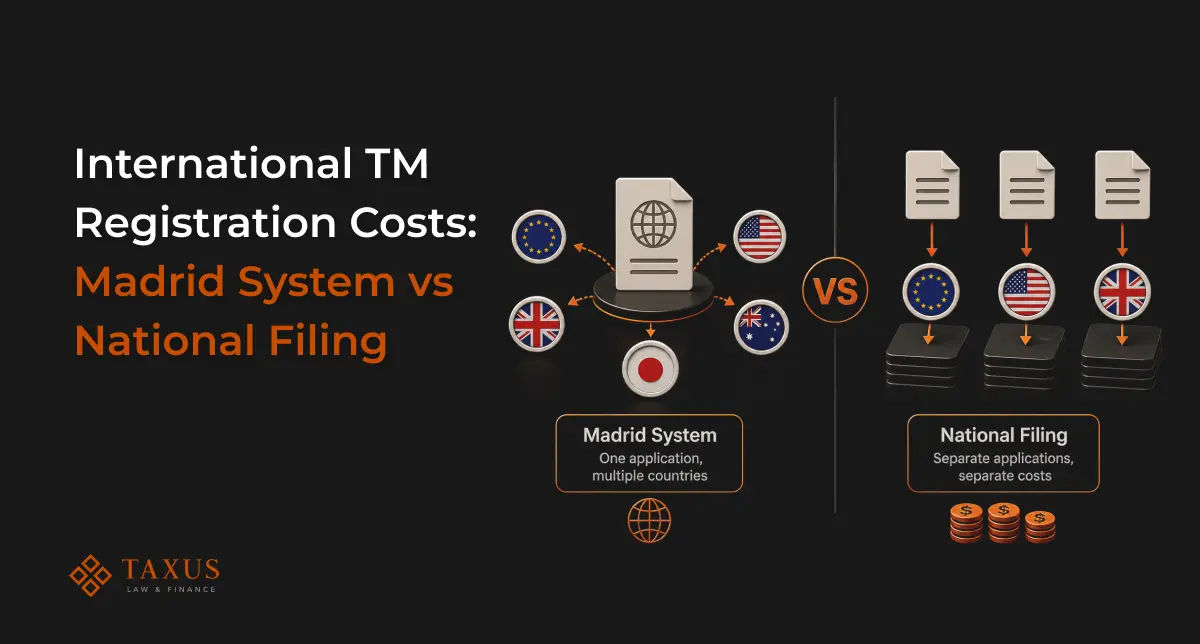


Trademark registration costs vary significantly depending on the territory in which protection is sought. If a business plans to protect a trademark in several countries, the cost of registration will depend not only on official filing fees, but also on the chosen filing route.
International trademark registration may be arranged through separate national filings or through the Madrid System administered by the World Intellectual Property Organization. Each option has its own cost structure and should be assessed depending on the number of countries, number of classes, and business goals.
This article is part of our series on trademark registration costs. If you want to understand what the overall trademark registration cost may include beyond official filing fees, read our guide Trademark Registration Cost: What Businesses Actually Pay For. For a jurisdiction-by-jurisdiction comparison of official fees, see Trademark Registration Fees in the EU, US and UK: Official Costs Compared.
International Filing Through the Madrid System
International trademark registration through the Madrid System is a separate factor that significantly affects the overall cost of trademark protection.
The Madrid System, administered by the World Intellectual Property Organization, allows applicants to file one international application and simultaneously extend protection to multiple countries.
However, the cost of international registration consists of several elements:
- WIPO basic fee;
- complementary or individual fees of selected countries;
- fees for each class of goods and services;
- costs of local representatives in the event of a provisional refusal;
- subsequent renewal fees.
The amount of international fees depends on:
- the number of selected countries;
- the number of classes;
- the type of trademark;
- whether the mark is in color or black-and-white;
- the specific legal requirements of each designated country.
Official Madrid System Fee Calculator — https://madrid.wipo.int/feecalcapp/
It should be taken into account that an international application does not guarantee automatic registration in all selected countries. Each national or regional office, for example EUIPO, USPTO, or UKIPO, conducts its own examination in accordance with local legislation.

Need to plan international trademark protection?
National Filing vs Madrid System
The cost of registration also depends significantly on the chosen filing route — national filing or international filing through the Madrid System administered by the World Intellectual Property Organization.
With national filing, the applicant files separately with:
- European Union Intellectual Property Office;
- United States Patent and Trademark Office;
- UK Intellectual Property Office;
- or other national offices.
This approach may be more cost-effective if protection is needed only in one or several specific countries.
By contrast, the Madrid System allows applicants to file one international application and designate several countries at once. However, in this case, the following costs arise:
- basic international WIPO fee;
- individual fees for each selected country;
- costs of managing the international application;
- potential expenses for local representatives in the event of objections.
Therefore, the Madrid System is often more convenient where protection is needed in multiple jurisdictions, while national filing may be more suitable if the business needs protection only in specific countries.
Number of Nice Classes Chosen
One of the key factors that directly affects the cost of trademark registration is the number of selected classes under the Nice Classification of Goods and Services. Each class covers separate categories of goods or services for which the applicant seeks legal protection.
In most jurisdictions, the basic official fee includes only one class, while each additional class requires payment of a separate fee.
Therefore, the broader the list of goods or services to be covered by legal protection, the higher the total cost of trademark registration.
This is relevant both for national filing and for international registration through the Madrid System.
Use Madrid System for Multi-Country Filing
If a business plans to enter several international markets at once, using the Madrid System may significantly optimize trademark registration costs.
The Madrid System, administered by the World Intellectual Property Organization, allows applicants to file one application and centrally manage international trademark registration.
At the same time, the Madrid System should not be viewed as automatic protection in all selected countries. Each designated national or regional office examines the application separately. If objections arise, additional costs may appear, including local representative fees.
Plan Trademark Renewals Early to Avoid Late Fees
Many companies focus exclusively on the initial stage of trademark registration and underestimate the importance of timely renewal. In most jurisdictions, a trademark remains valid for 10 years and may be renewed upon payment of renewal fees.
For example, in EUIPO, a European Union trademark remains valid for 10 years from the filing date. Failure to renew on time may result in:
- late renewal fees;
- loss of trademark rights;
- the need to re-register the trademark;
- the risk of registration of a similar brand by competitors.
For example, in EUIPO, the renewal request must be filed and the fee must be paid during the six months preceding the expiry date of the registration. The last possible date for filing the renewal request and paying the fee is the actual expiry date of the trademark.
An additional six-month grace period for renewal begins on the day following the expiry date. If the renewal application is filed during this grace period, an additional fee of 25% is charged.
If the renewal application is not filed, or is filed after the expiry of the additional grace period, EUIPO will notify the owner of the European Union Trademark that the trademark has been revoked and removed from the Register, and will also publish a corresponding notice in the EUTM Bulletin.
Renewal planning is especially important for international trademark protection, because a business may need to manage deadlines in several jurisdictions at once.

Protect your brand across the right markets
FAQ
Is international registration through Madrid System cheaper than separate national filings?
Not always. It depends on the number of countries involved. The Madrid System is often more cost-effective if trademark protection is needed in many jurisdictions at once. However, for one or two countries, national filing is often cheaper.
Can I register a trademark in multiple jurisdictions at once?
Yes, this is possible through international filing under the Madrid System. It allows applicants to file one international application and designate multiple countries.
Does the Madrid System guarantee registration in all selected countries?
No. Each national or regional office conducts its own examination in accordance with local legislation. An international application does not guarantee automatic registration in all selected countries.
What affects international trademark registration cost?
The cost depends on the number of selected countries, the number of classes, the type of trademark, whether the mark is in color or black-and-white, the specific legal requirements of each designated country, and possible local representative costs.
When is national filing better than the Madrid System?
National filing may be more cost-effective if protection is needed only in one or several specific countries.
Do international trademarks need renewal?
Yes. In most jurisdictions, trademarks must be renewed to remain valid. Renewal fees and deadlines should be planned in advance to avoid late fees or loss of rights.

Looking for a reliable payment processing system?
Order selection of a payment solution.