Pooled IBANs in 2026: Why They Are No Longer a “Grey Area” but Part of Modern Payment Infrastructure



Just a few years ago, the term pooled IBAN or aggregated IBAN often raised concerns among businesses. Many companies associated it with an “incomplete” account structure, complex payment flows, or even potential risks from banks and regulators.
In 2026, the situation has changed significantly. Pooled IBAN models have become a normal part of the European financial ecosystem, particularly across fintech, e-commerce, crypto, marketplaces, and international digital businesses.
Moreover, in many cases, a pooled architecture proves to be far more efficient than opening a traditional bank account for every individual client.
To understand why the market is moving in this direction, it is important to first understand how a pooled IBAN model actually works.
What Is a Pooled IBAN?
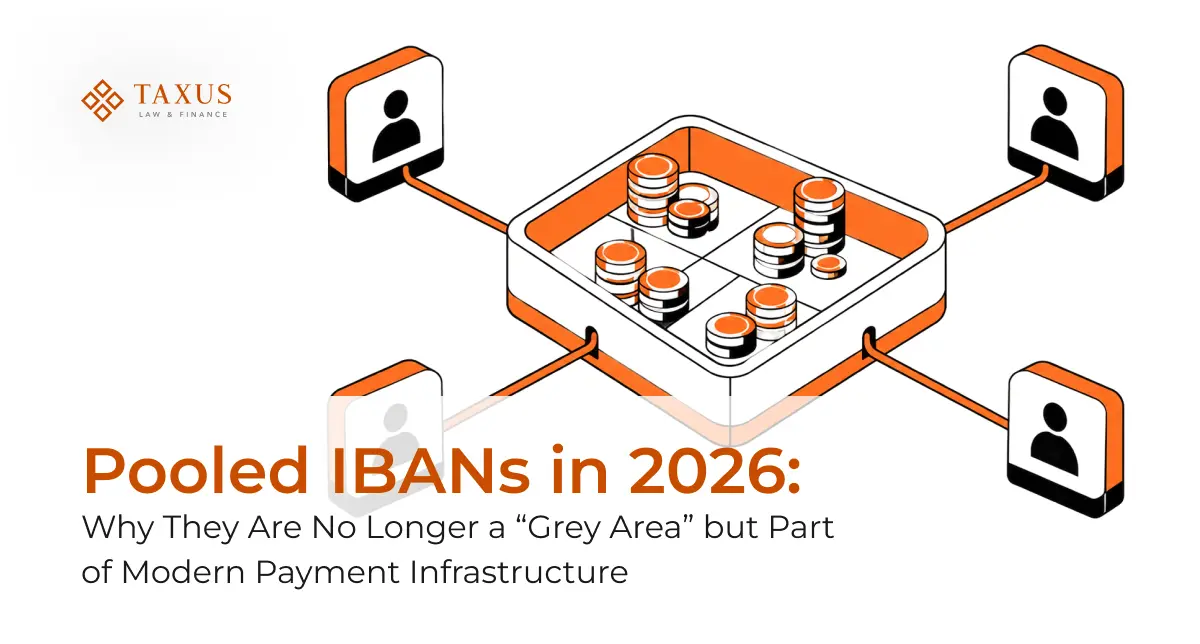
In a traditional banking model, each customer has a separate account with their own individual IBAN. A pooled model works differently. In most cases, there is a master account or safeguarding account, while the provider maintains internal records of different clients’ funds through virtual IBANs, reference IDs, or an internal ledger system. In other words, funds may be legally and operationally held within a single segregated account, while the system still accurately identifies which funds belong to which client.
For the end user, the experience often looks very similar to a standard IBAN account: receiving transfers; sending payments; using SEPA & SWIFT transfers; managing day-to-day business operations.
The difference lies in the underlying infrastructure rather than the user experience.
To put this account structure into context, explore how EMIs, PSPs and banks fit into a business payment setup and what to consider when choosing between them.
Why Pooled IBANs Have Become So Popular
The reason is simple: modern international businesses have become faster, more digital, and significantly more scalable.
Traditional banking models are often poorly suited for:
- Large-scale client onboarding;
- Marketplace business models;
- Fintech companies;
- Creator economy platforms;
- Crypto-related businesses;
- Affiliate networks;
- Global e-commerce operations.
Opening a separate traditional bank account for every user can be:
- Expensive;
- Time-consuming;
- Operationally complex from a compliance perspective;
- Difficult to scale.
As a result, EMI institutions and fintech providers have increasingly adopted pooled infrastructures. This allows them to onboard clients faster, reduce infrastructure costs and scale international payment flows. Consequently, pooled IBAN structures have evolved from being a compromise solution into a modern payment architecture standard.

Would a Pooled IBAN Work for Your Business?
Why Businesses Still Have Concerns About Pooled IBAN’s
The main challenge is often a lack of understanding of how the model works. Many companies assume:
“If the account is not fully dedicated, it must be less secure.”
In reality, security depends far less on whether the structure is pooled or dedicated and far more on:
- The provider’s license;
- Safeguarding arrangements;
- Banking partners;
- AML and KYC procedures;
- Internal accounting and reconciliation systems.
Across the European Union, EMIs and payment institutions are required to segregate client funds from their own operational funds, regardless of whether a pooled or dedicated structure is used. As a result, a properly structured pooled IBAN provided by a regulated EMI can often offer a higher level of protection than an account held with an unknown bank outside the EU.
Where Pooled IBANs Deliver Real Value
Marketplaces and Platform Businesses
This is one of the most common use cases. Marketplaces typically manage:
- Customers;
- Merchants;
- Payouts;
- Refunds;
- Split payments.
A pooled infrastructure enables efficient fund allocation between all participants without opening thousands of individual bank accounts. This is one of the reasons why many large marketplace platforms rely on ledger-based or pooled account structures.
Fintech and EMI Businesses
Within fintech, pooled architectures have effectively become an industry standard. This is particularly true for:
- Multi-user platforms;
- Virtual IBAN solutions;
- International transfers;
- Mass payout systems;
- Embedded finance products.
Such structures allow providers to build scalable infrastructures without placing excessive operational burdens on banking partners.
Crypto and Web3 Projects
Pooled models are also widely used within the crypto industry due to the nature of fiat-to-crypto payment flows.Typical examples include:
- Aggregated fiat settlements;
- OTC processing;
- Exchange operations;
- Crypto on-ramp and off-ramp solutions.
For crypto businesses, pooled infrastructures often make it significantly easier to integrate banking services into broader payment ecosystems.
When a Pooled IBAN May Not Be the Best Solution
It is important to acknowledge that pooled structures are not suitable for every business.
For example, large corporate groups, which regulated financial institutions, with investment funds and enterprise businesses with sophisticated treasury requirements may still require dedicated banking infrastructures.
Similarly, pooled IBANs may not always be suitable for complex escrow arrangements, trust structures, specific regulatory environments, certain licensing frameworks.
The question is not whether pooled IBANs are “good” or “bad.” The real question is whether the structure aligns with the company’s actual business model and payment flows.

Need an Account That Fits Your Operations?
The Biggest Mistake Businesses Make in 2026
In most cases, the issue is not the pooled IBAN itself. The real problem arises when businesses:
- Do not fully understand their payment flows;
- Do not know how client funds are safeguarded;
- Fail to assess banking partners;
- Ignore future scaling and compliance requirements.
As a result, companies often select a payment solution simply because it is quick to implement and only later encounter operational limitations. This is why payment architecture today is no longer simply about opening an account. It has become an essential component of overall business strategy.
Before applying, read our guide to opening a business payment account, which covers provider selection, onboarding requirements and lessons from real business cases.
Conclusion
In 2026, pooled IBANs are no longer viewed as an unusual fintech structure. They have become an established component of international payment infrastructure. For many digital businesses, fintech companies, marketplaces, crypto projects, and e-commerce operators, a pooled model can be faster, more cost-efficient, more scalable, more flexible than a traditional banking setup.
However, the effectiveness of a pooled architecture depends not on the label itself but on the provider behind the solution, the banking network supporting the infrastructure, the extent to which the setup matches the company’s actual payment flows.

Pooled or Dedicated? Make an Informed Choice.
FAQ
Is a pooled IBAN safe?
Yes. When provided by a regulated EMI or payment institution, client funds are typically protected through safeguarding mechanisms and segregated accounts.
What is the difference between a pooled IBAN and a dedicated IBAN?
A dedicated IBAN is assigned exclusively to one client, while a pooled IBAN operates through a shared account structure with internal allocation of funds.
Can businesses receive SEPA payments through a pooled IBAN?
Yes. Most regulated EMI providers allow businesses to receive and send SEPA payments using pooled or virtual IBAN structures.
Who should use a pooled IBAN?
Pooled IBANs are commonly used by fintech companies, marketplaces, e-commerce businesses, SaaS platforms, affiliate networks and international digital businesses.
Is a pooled IBAN a bank account?
Not necessarily. In most cases, pooled IBANs are provided by licensed EMI or payment institutions rather than traditional banks.

Looking for a reliable payment processing system?
Order selection of a payment solution.